
 русский
 Español
 Português



Read More

Product Category
NEW Category
Contact us
From Packing Line to Your Warehouse: How We Ship Wholesale Orders
Order Delivery to the Buyer's Warehouse
The last leg is the one your team actually experiences: cartons arriving in the right count, in undamaged condition, labelled so they can be received without relabelling. We pack and mark to that standard, and provide the documents and loading records that let your warehouse reconcile the delivery quickly.
Reducing Receiving Problems
Most receiving problems come from three things: carton marking that does not match the purchase order, barcodes in the wrong position, and mixed references inside one carton. All three are preventable if the specification is agreed before production rather than after.
If Something Is Wrong
Send photos of the cartons and the packing list within the agreed claim window and we will review the loading records and inspection report with you. Contact our export team with your order reference, or see shipping questions in our FAQ.
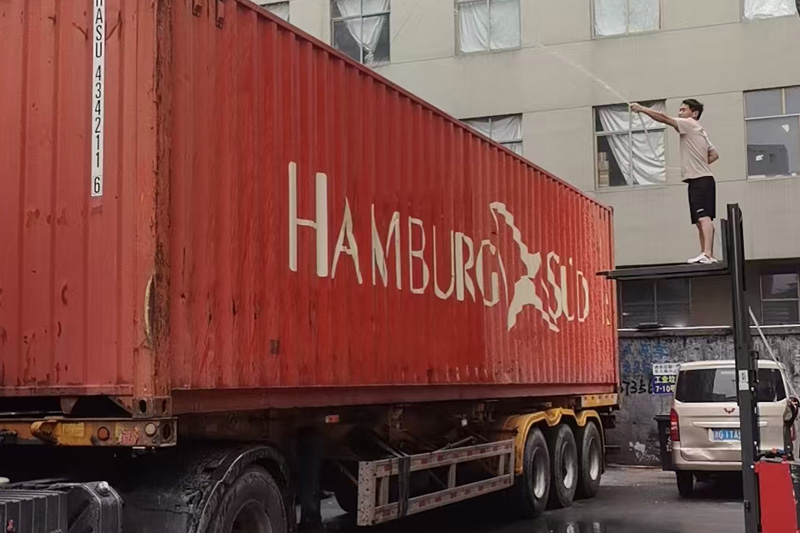
Port Delivery and Transport
Finished containers leave our facility by truck for the departure port, with the booking, documentation and handover handled by our export team. Goods depart from major Chinese ports near Zhejiang, which have frequent sailings to main ports in Europe, North America, South America, the Middle East and Southeast Asia.
Documents Issued
Commercial invoice, packing list, bill of lading and certificate of origin are issued for every shipment, and further documents required for customs clearance in your country can be prepared on request.
Tracking and Handover
You receive the container number, seal number and estimated departure before the vessel sails, and the document set follows by email so your broker can start clearance early. Tell us your destination port and we will confirm routing and transit time.
Sea Freight Container Preparation
Sea freight is the standard option for wholesale artificial flower orders: volume is high, weight is low, and the cost per unit stays competitive. We prepare the load so the container is filled efficiently without crushing cartons — a well-planned load usually saves more money than a freight-rate negotiation.
What We Calculate for You
Give us your item list and we will return the estimated volume, carton count and gross weight, and tell you whether the order fills a 20GP, a 40GP or a 40HQ. That answer decides whether adding a few more references costs you anything in freight.
LCL and Mixed Loads
If your order does not fill a container, we can consolidate it as LCL, or combine it with other buyers' cargo where your forwarder allows. Send us your item list for a loading calculation.
Warehouse Ready for Dispatch
Finished cartons are held in the dispatch area by order and by container, marked with destination and shipping mark, until the forwarder's truck arrives. Keeping finished goods separate from work-in-progress means a lot is never partly shipped because someone pulled cartons for another order.
Before the Truck Arrives
Each outbound lot is counted against the packing list, photographed, and checked for carton damage. Loading photos, carton counts, container number and seal number are then provided with the shipment so you can reconcile on arrival.
Peak Season
Production lead time is typically 25–40 days after deposit. For Christmas trees and other seasonal items, booking 2–3 months ahead secures both production slots and vessel space. Send your shipment plan and we will confirm the schedule.
Container Loading and Shipping
Once cartons pass inspection they are stacked into the container by weight and stacking strength — heavy planters at the bottom, fragile heads away from the door — then the container is sealed and the number is recorded on your documents.
Options by Order Size
Full containers for established programmes, LCL mixed containers when you are testing several designs, and air freight for urgent samples or top-up stock. A first container can combine several designs toward the same total quantity, which lets you test more than one style without meeting the full MOQ on each.
Terms and Ports
We quote EXW, FOB and CIF. Goods depart from major Chinese ports near Zhejiang with frequent sailings to main ports worldwide. Send your item list and we will return volume, weight and freight estimates for each option.
Carton Packing Line
On the carton line, items are counted into inner packs, cushioned where needed, closed and marked with the shipping mark your forwarder or warehouse requires. Carton dimensions and piece counts are fixed per reference so your warehouse system and freight calculation can rely on the same numbers every reorder.
Information We Confirm Before Packing
Pieces per inner and per carton, carton size and gross weight, barcodes and their placement, warning and origin text, and palletising if you need it. Fixing these before production avoids relabelling at destination, which is expensive for everyone.
Quality Check
Packing is part of the final random inspection: quantity, carton strength, marking accuracy and seal quality are checked before the lot is released. Send us your carton and barcode specification with your enquiry.
Packing Workshop for Export Orders
Export packing is a separate workshop with its own benches, carton stock and marking station. Each item is packed according to its shape — flower heads protected, stems layered, pots stabilised — then closed, weighed, labelled and stacked by order before it moves to the loading bay.
Built Around Your Channel
Supermarket and garden-centre programmes usually need barcoded retail packaging and shelf-ready cartons; marketplace sellers need individual mail-order boxes that survive the last mile; wholesale and decoration buyers usually want maximum density per carton. Tell us the channel and the carton specification follows.
Documentation
Commercial invoice, packing list, bill of lading and certificate of origin are issued for every shipment, and additional documents can be prepared for customs clearance. Send your packing requirements with your item list.
Interested in cooperation or have questions?








 Ready To Customise
Your Realistic Plants Products?

Product Categories
Quick Links
Contact Us
-
Telephone: +86-15957939205

-
Email: jenny@hansycraft.com

-
Add: No. 185 Xigang Street, Xiaoshun Town, Jindong District, Jinhua City, Zhejiang Province, P.R.China

-
whatsapp: 8615957939205
-
Website: Sitemap
